
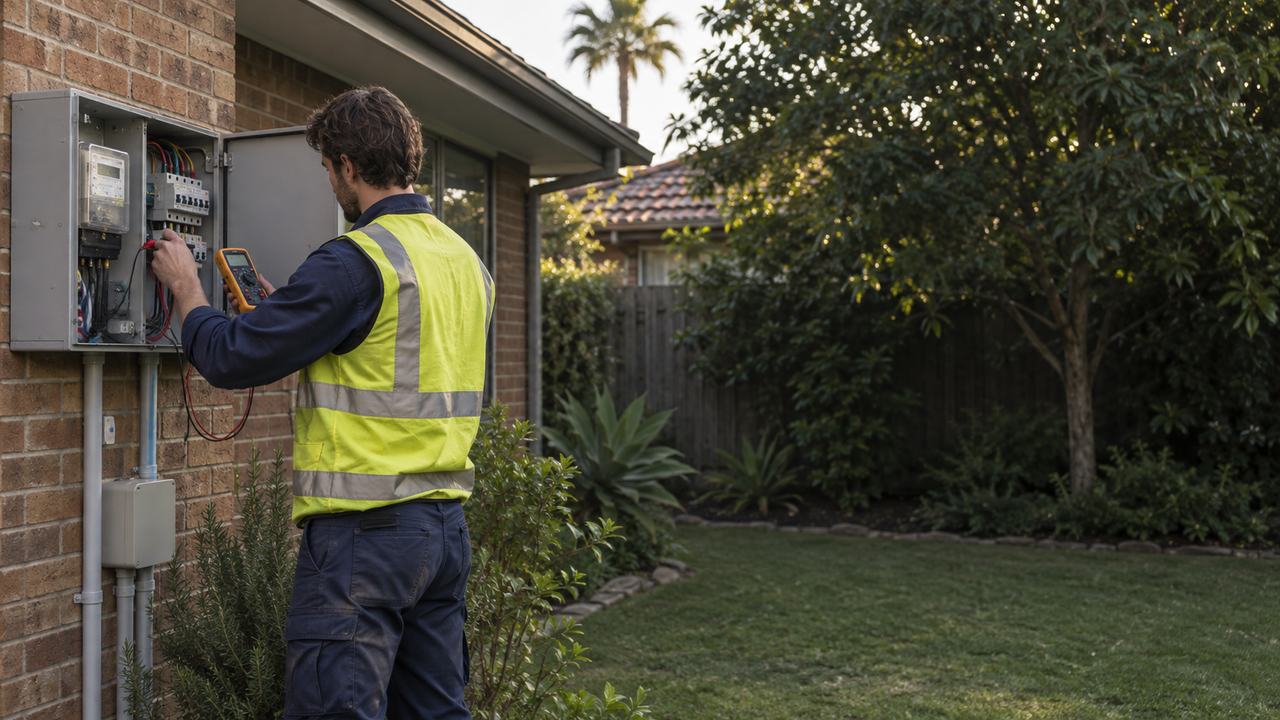
Case study · Electrical field services
Sale of a National Electrical Field Services Business
A founder-owned electrical field services business sold through a competitive, confidential expressions of interest process for a $30M+ enterprise value. It took 59 days from launch to a signed offer, and the sale settled months ahead of schedule.
Transaction managed by Morgan Business Sales · Settled September 2026
Want to see more results? See all case studies
- $30M+Enterprise value
- 30%+Increase on the first offer
- 59 daysFrom launch to signed offer
- 50%+Paid in cash at completion
- 100%Staff kept on
The business
Business Overview
| Business | National electrical field services business |
|---|---|
| Services | Installation, exchange, fault and maintenance work for national energy-infrastructure providers, plus government switchboard and school works |
| Industry | Electrical services: energy infrastructure field services |
| Location | NSW head office, with other locations in NSW and interstate. Licensed in six states and territories |
| Revenue | $25M+, with contracted revenue of $50M+ a year from FY27 |
| Profit (EBITDA) | About $5.15M a year on average, adjusted (FY23–FY26) |
| Workforce | About 40 employees plus about 150 subcontract technicians |
| Years in business | 10+ |
| Owners | Two equal shareholders |
| Type of sale | Share sale of 80% of the holding and operating companies. The owners kept 20% |
| Pricing | Expressions of interest by a set deadline, with no published price |
| Final sale price | $30M+ enterprise value |
| Payment | 50%+ in cash at completion, with the balance as fixed annual payments. Not subject to finance |
| Transaction managed by | Morgan Business Sales |
| Advisers | Sean Wolrige (lead broker) and Alan Kanuk |
| Settled | Mid-September 2026 |
What the owners wanted
Objective
The business was owned by two equal shareholders. One had started it as a sole trader and, over a decade, built it into one of a handful of tier-one national providers in its field. The other ran the contracting side of the business. A General Manager, paid partly through a share of profits, ran day-to-day operations.
The two owners had agreed to part ways on good terms, and the founder and managing director wanted to step back for family reasons. The timing was deliberate. Key customer contracts were locked in for the next few years, the systems and accreditations were in place, and contracted earnings were about to rise sharply. They were selling from a position of strength.
A successful outcome meant:
- a price that reflected both the business's track record and the value of its contracted FY27–FY30 earnings;
- certainty: cash at completion, and later payments that didn't depend on future performance (an earn-out);
- a capable new owner with the resources to fund the next stage of growth, keeping the brand and the team;
- an immediate exit, with one director available for an agreed handover period.
The owners also wanted a structured timetable, with expressions of interest (EOIs) due by 30 June 2026. At the start they wanted to sell 100% of the business and ruled out selling only part of it. That changed once the offers came in.
Experience and trust
Why They Chose Morgan Business Sales
The owners chose Morgan Business Sales for the competence and experience of its lead advisers, Sean Wolrige and Alan Kanuk, and for the rapport they built with the owners from the first meeting.
Two senior advisers on one sale
Sean led the sale, and Alan co-led the meetings with the owners and with buyers and supported the buyer's review of the business (due diligence). They worked closely with the owners' commercial lawyers, accountant and in-house finance team throughout.
Our own technology: CIM-PRO
The sale was run on CIM-PRO, Morgan Business Sales' proprietary deal management platform.
The sale in brief
Summary
This business holds a scarce position: it is one of only a few tier-one providers on a regulator-mandated national program, with long-term client contracts and a workforce licensed across six states and territories. But its two largest clients made up about 98% of revenue, and its most recent annual profit had dipped while it hired ahead of a large, contracted increase in work.
Sean and Alan rebuilt the financials around contracted earnings, prepared answers to the hard questions before buyers asked them, and approached about 140 targeted buyers in Australia and overseas through a confidential EOI process. Two bidders made four offers between them. The strategic buyer lifted its enterprise value by more than 30% from its first offer, to $30M+ for an 80% stake, with more than half paid in cash at completion and the balance as fixed payments rather than an earn-out.
The offer was signed 59 days after launch. The sale settled in mid-September 2026, about two to three months ahead of the original timetable, and every employee and subcontractor stayed with the business.

About 18 weeks from launch to settlement
Sale Timeline
Phase 1 · Jan – May 2026
Preparation
About 15 weeks from first meeting to launch
Phase 2 · May – June 2026
Marketing & EOIs
About 140 buyers targeted. EOIs due 30 June
Phase 3 · June – July 2026
Offers & negotiation
Signed offer 59 days after launch
Phase 4 · July – Sept 2026
Due diligence & settlement
Settled about 2–3 months ahead of schedule
| Date | What happened |
|---|---|
| January 2026 | First meeting with Sean Wolrige and Alan Kanuk |
| March 2026 | The owners appoint Morgan Business Sales on a nine-month exclusive engagement |
| March – May 2026 | Financials rebuilt, the Confidential Information Memorandum (CIM) and buyer materials prepared, and the data room and due diligence tracker set up |
| 11 May 2026 | Confidential launch. A buyer meets the owners within three days |
| 3 June 2026 | First offer, from a strategic buyer |
| 24 June 2026 | Offer from a private equity fund |
| 30 June 2026 | Deadline for expressions of interest |
| 7 July 2026 | The strategic buyer revises its offer to an 80% stake at a materially higher value |
| 9 July 2026 | Non-binding indicative offer (NBIO) signed, 59 days after launch |
| 28 July 2026 | Data room complete for the buyer's confirmatory due diligence |
| 6 August 2026 | Draft share sale agreement and shareholders' agreement issued |
| Mid-September 2026 | Sale settled, about 18 weeks after launch and two to three months ahead of the CIM timetable |
What had to be managed
Challenges
The business had real strengths: a scarce tier-one position, long-term contracts of three to five years, a capital-light model that had grown from 3 to more than 150 subcontract technicians, and its own scheduling and reporting platform. Buyers still had four concerns that had to be answered.
01
Two clients made up about 98% of revenue
This was the main reason private equity funds passed. Sean and Alan answered it with the contract terms, the minimum volumes in the contracts, and evidence of how deeply the business was built into its clients' own systems.
02
Last year's profit versus next year's contracted profit
Profit (EBITDA) for FY26 was about $3.6M, held down because the business hired ahead of the increase in work. Contracted EBITDA for FY27 was $11.5M. Sean and Alan presented FY26 as the end of a "platform build" phase, with the business now moving into the phase where that investment pays off.
03
What happens after 2030?
Much of the revenue was tied to contracts ending in 2030. The answer was the maintenance work that continues after the program, the government works, and new opportunities not included in the forecasts, such as solar and batteries, gas and water, and embedded networks (private electricity networks in apartment buildings and shopping centres).
04
Reliance on the founder
The founder was central to the business. This risk was reduced by the General Manager, the systems-based way the business runs, and an offer from a director to stay on for a handover period.
How the sale was run
Strategy & Approach
A valuation built on contracted earnings
Sean and Alan set an internal price guide of $30M enterprise value (the total value placed on the business). They framed it as 5 to 7 times the average adjusted annual profit (EBITDA) of about $5.15M over FY23–FY26, then cross-checked it with a discounted cash flow, a valuation that works out what the four years of contracted future earnings are worth in today's dollars.
Leading buyers to the right numbers
The key was getting buyers to value the business on its contracted future earnings, not on the lower FY26 profit. That approach paid off: the difference between the first offer and the final offer was $8.3M of enterprise value.
Financials rebuilt for buyers
The financials were rebuilt into a single summary covering FY23 actual results through to FY30 forecasts. Wages were normalised to market rates, one-off and owner-related costs were added back (add-backs), and working capital and capital spending were analysed, so buyers could see how the business would perform under a new owner.
Everything ready before launch
Before any buyer was approached, the following were ready:
- the rebuilt FY23–FY30 financial summary;
- a Confidential Information Memorandum (CIM), a short anonymous summary (teaser) and the investment highlights;
- a buyer Q&A register that answered "why sell now?" and the FY26 profit dip up front;
- a data room and due diligence tracker, with an owner assigned to every item before buyers asked for it.
This is a big part of why the sale settled two to three months ahead of the timetable.
A tightly controlled buyer process
Rather than advertise the business openly, Sean and Alan controlled exactly who received information:
Step 01
No public advertising
The business was marketed confidentially under a project code name, with direct approaches to selected buyers only.
Step 02
Individual NDAs
Confidentiality agreements (NDAs) were negotiated one by one with several listed groups and funds.
Step 03
Owner sign-off
After discussion with the owners, one trade buyer was not given the CIM.
Step 04
Strict contact rules
Buyers were told that any contact with staff or clients would rule them out of the process.
Going straight to the right buyers
The EOI process launched on 11 May 2026 with a teaser and direct approaches. Sean and Alan built a prioritised list of about 140 targets:
- 77 strategic and infrastructure services groups;
- 43 private equity funds;
- 23 Japanese and other international strategic buyers, introduced through a Japanese bank and an accounting firm.
One buyer met the owners within three days of launch.
| Targets on the prioritised list | About 140 |
|---|---|
| Parties engaged (early June) | 32 |
| Confidentiality agreements signed | 19 |
| Confidential Information Memoranda released | 16 |
| Buyer meetings and calls | 8+ |
| Indicative offers | 4, from 2 bidders |
| Signed offer with exclusivity | 1 |
| Days from launch to signed offer | 59 |
The deal story
Certainty Over the Highest Headline
Two bidders made four offers between them. Most private equity funds passed because of the client concentration and the outlook after 2030, and one large listed strategic buyer said the business was too small for it.
| Date and bidder | Offer |
|---|---|
| 3 June · Strategic buyer | 100% of the business at a fixed price, mostly upfront with later instalments, or a smaller upfront payment plus a share of profits for four years. An opening offer, well below the internal guide. |
| 24 June · Private equity fund | A majority stake at the highest headline value in the process, but only a small part paid upfront. Most of the price was a capped three-year earn-out tied to future earnings. |
| 7 July · Strategic buyer | Revised to an 80% stake at a materially higher enterprise value, with half paid upfront. |
| 9 July · Strategic buyer | Signed offer: an 80% stake at the internal guide value, with half paid at completion and the balance as fixed annual instalments. Not subject to finance. |
Strategic buyer Accepted
More than half paid in cash at completion, with the balance as fixed annual payments that don't depend on future performance. No finance condition.
Private equity fund
Only a small part paid upfront. Most of the price depended on the business hitting future earnings targets over three years, and was capped.
To help the owners compare options that looked very different on paper, Sean and Alan modelled every offer against the earnings the owners would receive if they didn't sell at all. That made it clear that guaranteed money was worth more to them than a higher headline that mostly depended on future results.
The offers also showed that buyers would pay more for a partial stake. The owners moved away from their 100%-only position, and that change made the final deal possible.
From signed offer to settlement
Negotiating and Finalising the Sale
The final deal
Two levers closed the gap between what the buyer would pay and what the owners needed:
A partial sale
Selling 80% let the buyer pay a $30M+ enterprise value, matching the internal guide.
Cash at completion
More than half of the price paid when the sale completed.
Annual payments, not an earn-out
The balance is paid in fixed instalments. It can only be reduced if a warranty or restraint is breached.
A stake in the upside
The owners kept 20%, protected by put and call options and drag-along and tag-along rights (explained below).
Put and call options give the owners the right to sell their remaining 20% to the buyer, and the buyer the right to buy it, at a price set by an agreed formula. Drag-along and tag-along rights mean that if the business is sold in future, the minority owners can be required to sell on the same terms, and can insist on being included.
01
Answering the buyer's five concerns
The strategic buyer raised five concerns: how secure the contracts were, possible subcontractor issues, uneven historical earnings, reliance on key people and the outlook after 2030. Sean and the owners answered each one in writing, showing how much the clients relied on the business's workforce and systems, that the contracts had no clauses allowing clients to end them at will, that client volumes were rising, the safety and insurance controls in place, and new opportunities not yet in the forecasts.
02
A fast confirmatory due diligence
The buyer's review ran through July and August. The data room was complete on 28 July, and the draft share sale agreement and shareholders' agreement were issued on 6 August.
03
Issues cleared before settlement
- An independent valuation of plant and equipment, and an updated asset register.
- An agreed normal level of working capital (the working capital peg).
- A variation to one client contract.
- Financial information split by entity.
- Confirmation that a restraint clause in a client agreement didn't apply to the business's own field services work.
04
Handover and staff
Key management stayed on, with the business running as a standalone operation under the new owner. A director is providing transition support. Because it was a share sale, all employees and subcontractors stayed with the companies.
Who bought the business
The Buyer
The buyer is a privately owned national infrastructure and electrical services group, led by its CFO, that runs its businesses on a decentralised model. In this business it gained:
- contracted earnings from day one;
- a scarce tier-one position on a national program;
- a licensed national workforce;
- room to grow into related utility services.
Why this buyer won
- Speed. It met the owners within days of launch.
- Certainty. Most of the price was guaranteed, and the offer wasn't subject to finance.
- Commitment. It agreed to keep the brand and management in place, running the business as a standalone operation.
The outcome
Final Result
$30M+
Enterprise value, matching the internal guide
30%+
Increase on the first offer
59 days
From launch to signed offer
2–3 months
Ahead of the original timetable
- Deal structure
- Share sale of 80%. More than half paid in cash at completion, with the balance as fixed annual payments, not an earn-out
- Ongoing stake
- The owners keep 20% of a business forecasting about $10M–$15M EBITDA, with a protected way to sell it later
- Offers
- Four offers from two bidders. Not subject to finance
- Staff
- 100% staff kept on, along with every subcontractor
- Brand and team
- The business keeps its brand and management, running as a standalone operation
- Handover
- A director provides agreed transition support
The owners sold from strength, at a price that reflected their contracted future earnings, with certainty on most of the money and a capable new owner backing the business and its team.
The lead broker
From the Broker
"Strategic buyers can see value a spreadsheet can't: a scarce national platform, a licensed workforce and contracted work already locked in. The buyer that won this moved quickly, backed the business to keep running under its own brand and team, and put certainty on the table rather than a headline. That is exactly what vendors respond to, and it's why the strategic buyer beat the higher headline bid."
Sean WolrigeLead Broker, Morgan Business Sales

Lead Broker, Morgan Business Sales
Sean co-led this sale with Alan Kanuk. Talk to Sean about what your business could be worth and how a sale could work for you.
What owners can learn
Key Insights
Industry Trends & Buyer Demand
Energy-transition programs are creating steady demand for licensed electrical field services, and providers with national scale are scarce. That is drawing interest from strategic buyers, infrastructure services groups and private equity, in Australia and overseas.
How Contracted Businesses Are Valued
Infrastructure services businesses with contracted revenue are valued on their future earnings. The biggest discounts come from relying on a few clients and from program end dates, and private equity buyers are especially sensitive to both. Strategic buyers are often better placed to see the value in a scarce position and a licensed workforce.
| Measure | EBITDA multiple |
|---|---|
| Internal price guide | 5 – 7x |
| This sale (80% share sale) | About 5.8x |
Multiples are based on the average adjusted EBITDA for FY23–FY26 (about $5.15M), cross-checked against a discounted cash flow of four years of contracted earnings.
Strategic Takeaways for Owners
Sean's advice for owners preparing to sell:
01
Sell from strength.
Going to market with contracts locked in and earnings about to rise gives buyers a reason to pay for the future.
02
Deal with client concentration on paper first.
Have the contract terms, minimum volumes and evidence of how much clients rely on you ready before you go to market.
03
Answer the hard questions up front.
A Q&A register that explains a profit dip or "why now?" stops buyers using it against you.
04
Compare offers on certainty, not headline.
Model each offer against what you would earn if you didn't sell at all.
05
Consider a partial sale.
Selling a majority stake, with protected rights for the part you keep, can close a price gap without accepting an earn-out.
06
Keep the process confidential.
Controlled distribution and strict contact rules protect your staff and client relationships while buyers do their work.
Market Takeaway: As energy-transition work continues, scarce, licensed national field services businesses with contracted revenue are expected to keep attracting strong interest, particularly from strategic buyers who can see past client concentration to the value of the platform.
Common questions
Frequently Asked Questions
How is an electrical services business with long-term contracts valued?
Mainly on its future contracted earnings, not just last year's profit. In this sale, the guide price was set at 5 to 7 times average adjusted annual profit (EBITDA) and cross-checked with a discounted cash flow of four years of contracted earnings. The business sold for about 5.8 times.
What is enterprise value?
Enterprise value is the total value placed on the whole business. In this sale it was $30M+, and the buyer bought an 80% stake on that basis.
What is a non-binding indicative offer (NBIO)?
An NBIO is a written offer that sets out the price and main terms a buyer proposes, before its detailed review of the business. It isn't legally binding, but signing one usually gives that buyer exclusivity while it completes due diligence. Here, the NBIO was signed 59 days after launch.
What's the difference between an earn-out and fixed deferred payments?
An earn-out is part of the price paid later, only if the business hits agreed targets, so the seller carries the risk. Fixed deferred payments are paid later in set amounts regardless of performance. In this sale, the balance was fixed and could only be reduced if a warranty or restraint was breached.
Can I sell part of my business and keep a stake?
Yes. In this sale the owners sold 80% and kept 20%. Their stake is protected by put and call options at a formula price, which give them a set way to sell it later, plus drag-along and tag-along rights if the business is sold again.
Does relying on a few large clients reduce what my business is worth?
It can, and it is one of the main reasons private equity buyers pass. In this sale two clients made up about 98% of revenue. It was answered with the contract terms, minimum volumes and evidence of how deeply the business was built into the clients' systems.
Should I sell to a strategic buyer or private equity?
It depends on the offer, not just the price. In this sale, private equity made the highest headline offer, but most of it depended on future earnings. The strategic buyer offered mostly guaranteed money, no finance condition and a commitment to keep the brand and team, and the owners chose that offer.
Can I sell my business without my staff or clients finding out?
Yes, with the right process. In this sale the business wasn't advertised publicly, confidentiality agreements were negotiated with each party, the owners approved who received information, and any buyer who contacted staff or clients would have been excluded.
More results