
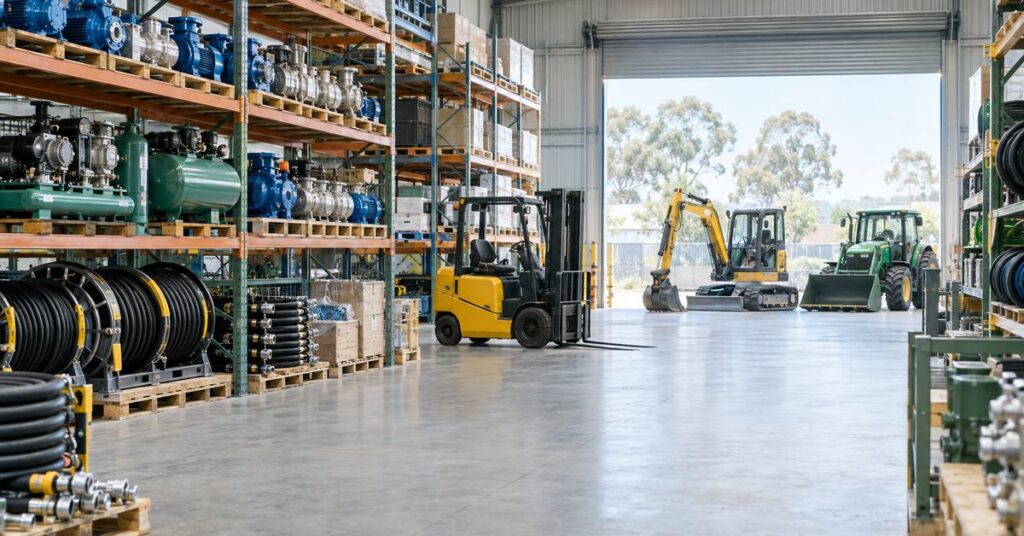
2026 Australian Industrial Equipment Wholesale & Distribution: M&A Overview
By Morgan Business Sales | Updated September 2026
Australia's industrial equipment wholesale and distribution sector sits between global manufacturers and the mines, farms, factories, construction sites and workshops that rely on their products. It covers mining and industrial machinery distributors, agricultural and construction machinery dealers, materials handling and forklift suppliers, pump, compressor and fluid power specialists, industrial electrical and automation wholesalers, bearing and power transmission suppliers, and fastener, tool and consumables distributors. This report looks at the buyers active across these subsegments, the businesses they are acquiring and the practical features that affect value - from supplier agreements and aftermarket service revenue to inventory quality and management depth.
Verified Australian mid-market transactions cluster around 2.5x-6.0x EBITDA, with smaller owner-operated wholesalers typically transacting between 2x and 3x. Multiples above 6x are generally reserved for specialist platforms and large OEM-franchised dealer groups - not the typical A$2M-A$50M revenue operator. This gives owners and their advisers a grounded starting point for planning a sale, succession or partial exit.
Sector Overview
Industrial equipment wholesaling is a large and established part of the Australian economy. Mining and industrial machinery wholesalers are expected to generate around $28.7 billion in revenue in 2025-26 across roughly 2,230 businesses, while farm and construction machinery wholesalers generate a further $21.9 billion across around 1,560 businesses. Specialist segments are substantial in their own right: materials handling equipment wholesaling is a $14.2 billion market and machine tool wholesaling around $9.7 billion.
Growth has been modest rather than spectacular. Mining and industrial machinery revenue grew at an annualised 1.7% over the five years to 2025-26 and is expected to dip about 1.0% this year as mining equipment spending eases. Farm and construction machinery has had a harder run, with revenue falling at an annualised 4.8% between 2020 and 2025 on the back of erratic seasons and a housing slowdown, although a return to growth is forecast. Materials handling has been the steadier performer, supported by road, rail and renewable energy projects and non-residential building. Across the sector, the number of businesses is edging down, which reflects consolidation rather than distress - larger groups are absorbing smaller operators, and manufacturers are taking some distribution in-house.
The market has a distinct mid-market layer. At the top sit national dealer groups such as WesTrac and Hastings Deering, and national distributors such as Blackwoods and Motion. Below them is a wide base of privately owned, often family-run businesses - regional dealerships, specialist importers, and sales-and-service businesses built around a handful of strong brands. It is this layer that most of the acquisition activity in this report is focused on, because it offers buyers established supplier relationships, trained technical staff and loyal customers that are difficult to build from scratch.
ANZSIC Classification
These classifications help place your business in the right part of the market and identify the buyers most relevant to it. Many distributors span more than one code, so the most useful classification is the activity that generates most of the revenue. This report focuses on ANZSIC Subdivision 34 Machinery and Equipment Wholesaling, together with the tool and hardware and heavy vehicle parts classes where industrial distributors commonly sit.
| ANZSIC Class | Title | Relevance to Mid-Market Subsegments |
|---|---|---|
| 3411 | Agricultural and Construction Machinery Wholesaling | Tractor, harvester, earthmoving and construction machinery dealers and parts suppliers. Many are OEM-franchised dealer groups, and the subsegment is consolidating steadily. |
| 3419 | Other Specialised Industrial Machinery and Equipment Wholesaling | Mining machinery, machine tools, metalworking, food processing, printing, woodworking and other specialised machinery importers and distributors, plus machine parts and attachments. |
| 3494 | Other Electrical and Electronic Goods Wholesaling | Industrial electrical, automation, cable, switchgear, motors and generators. One of the most active acquisition areas in this report, driven by electrification and data centre demand. |
| 3499 | Other Machinery and Equipment Wholesaling n.e.c. | Pumps, compressors, bearings, materials handling equipment and forklifts, lubrication equipment, engines and fire protection equipment. Most sales-and-service distributors in this report sit here. |
| 3339 | Other Hardware Goods Wholesaling | Hand and power tools, abrasives and industrial hardware, including tool, fastener and consumables distributors and buying groups serving trade and industrial customers. |
| 3505 | Motor Vehicle New Parts Wholesaling | Included where businesses supply truck, trailer and heavy vehicle parts and workshop consumables to industrial and fleet customers. |
Professional and scientific goods, computer and telecommunication goods wholesaling (classes 3491-3493) are excluded, as they are driven by different customers and buyers. Industrial and agricultural chemical wholesaling is covered in greater depth in the separate Morgan Business Sales chemical manufacturing report, and industrial services, engineering and manufacturing are covered in the Morgan Business Sales industrial products and services report.
36 Verified M&A Transactions (2021-2026)
This table covers 36 Australian transactions ordered by date, from small regional bolt-ons to a handful of larger platform deals included for context. It is not a valuation formula. It is a practical view of the businesses buyers have actually acquired, the capabilities they were looking for and, where disclosed, the prices paid. Most transactions at this end of the market do not disclose a value, which is normal for privately owned businesses.
| # | Target | Acquirer | Value (AUD) | Date | Notes |
|---|---|---|---|---|---|
| 1 | Control Technologies | APS Industrial | Undisclosed | Oct 2026 | Albury-based automation, instrumentation and low-voltage distributor operating since 1988. APS gains local stock, technical support and customer relationships across northern Victoria and the Riverina; the founder stays involved and the trading name is retained. |
| 2 | Compressors Australia | Atlas Copco | Undisclosed | Sep 2026 | Small Brisbane and Melbourne compressor sales and service business (around A$4.8M revenue, 9 staff) folded into Atlas Copco's service division - a global manufacturer buying service capability and customer access rather than scale. |
| 3 | All Lift Forklifts | Jungheinrich | Undisclosed | Aug 2026 | Forklift and access equipment dealer and rental specialist with six locations. Gives Jungheinrich an established rental fleet, service network and customer base in a growing Australian rental market. |
| 4 | Fume & Dust Control | Nederman | Undisclosed | Jul 2026 | Brisbane-based distributor absorbed by its Swedish supplier to gain a direct presence in Queensland's mining, minerals processing and defence markets - a clear example of a manufacturer moving from distributor to direct sales. |
| 5 | Dowdens Group (majority stake) | AxFlow Oceania | Undisclosed | Apr 2026 | Queensland pump, water treatment and air-starter provider founded in 1973, with 180 staff across five sites. AxFlow's largest Oceania investment, structured as a partnership with management and keeping the Dowdens name. |
| 6 | WA Industrial Electrical Wholesale Business (name undisclosed) | Undisclosed | $2,925,000 | 2026 | Completed asset sale; revenue approximately $11,400,000, EBITDA approximately $1,150,000; priced at 2.54x EBITDA - an established independent electrical wholesaler focused on industrial customers, priced in line with private market evidence for a business just above $1M EBITDA. |
| 7 | Platinum Cables | IPD Group | $37.5M + up to $7.5M earn-out | Dec 2025 | Mining cable specialist with FY25 revenue of $44.8M and EBITDA of $8.2M. Upfront price of about 5.2x EBIT (EV/EBIT; roughly 4.6x EBITDA), with the earn-out tied to 2026 earnings growth. Adds mining customers with no product overlap. |
| 8 | Hardware & Building Traders (HBT) | Stealth Group | $22M + up to $5M earn-out | Nov 2025 | National buying group of around 1,165 independent hardware and industrial stores with FY25 normalised EBITDA of about $3.7M, implying roughly 5.9x on the headline price. Bought for purchasing scale and a ready-made member network. |
| 9 | Custom Fluidpower | Questas Group | ~$83M | Oct 2025 | Hydraulic fluid power supply and service business with 2024 revenue of about $92M, sold by its US-listed parent alongside a long-term exclusive distribution agreement. Earnings had more than doubled over seven years of ownership. |
| 10 | Aussie Adaptors & Hydraulics | Brennan Industries | Undisclosed | Aug 2025 | Hydraulic adaptor and coupling supplier founded in 2012, acquired by a US manufacturer as its entry point into Australia; the managing director continues to lead the team. |
| 11 | Advanced Pump Technologies (APT Water) | AxFlow | Undisclosed | Aug 2025 | Perth-based pump and fluid handling distributor founded in 2006. Adds a Western Australian iron ore and gold mining customer base to AxFlow's national network. |
| 12 | Eastern Bearings Company | Finer Power Transmissions | Undisclosed | Jul 2025 | Bearing wholesaler founded in 1988; the retail division closed on completion and a founder joined the acquirer to run overseas sourcing - an exit built around supply channels and sourcing know-how. |
| 13 | Questas Group (majority stake) | Five V Capital | ~$375M | Apr 2025 | Private equity to private equity sale of a national hydraulics, pumps and engine services platform built through a long run of bolt-on acquisitions. Shows the exit value a scaled roll-up can reach, well beyond typical mid-market pricing. |
| 14 | QLD Printing & Paper Handling Machinery Wholesale Business (name undisclosed) | Undisclosed | $1,250,000 | 2025 | Completed asset sale; revenue approximately $3,960,000, EBITDA approximately $425,000; priced at 2.94x EBITDA - a specialised machinery importer and distributor serving the printing and paper industry, achieving a solid multiple for a business under $1M EBITDA. |
| 15 | Superior Pump Technologies | AxFlow | Undisclosed | Oct 2024 | Australian pump distributor added to AxFlow's local network, part of a steady programme of buying specialist pump businesses state by state. |
| 16 | AVT Services | Atlas Copco | Undisclosed | Aug 2024 | Sydney-based vacuum pump sales and service business with 15 staff and sites in Melbourne, Perth and Brisbane. Brings Atlas Copco closer to end customers in key cities. |
| 17 | Force Technology | Stealth Group | ~$9.5M | Jun 2024 | 100% share acquisition extending Stealth's industrial and workplace supplies range as it builds a national independent distribution platform. |
| 18 | Steelmasters Group | Coventry Group | $42.1M (NZ$45M) | Apr 2024 | Fastener and galvanising group with 12 branches across Australia and New Zealand, acquired at 6.1x EBITDA. Adds specialised fastener range, manufacturing capability and procurement synergies. |
| 19 | Carruthers Machinery (Cowra and Young) | Kenway and Clark | Undisclosed | Jul 2024 | Owner-led farm and construction machinery dealerships run by the Carruthers family since 1996, sold to a neighbouring dealer group that retained local staff - a typical regional dealer succession sale. |
| 20 | CMI Operations | IPD Group | Up to $101M | Feb 2024 | Electrical cable and plug business with FY23 revenue of $104.3M, six warehouses and around 60 staff. Upfront price of about 6.0x EBIT (EV/EBIT), with an earn-out tied to earnings growth. Strengthens IPD's electrification and energy transition exposure. |
| 21 | LandHQ | Hutcheon & Pearce | Undisclosed | Dec 2023 | Four-branch John Deere dealership across Penrith, Bowral, Nowra and Queanbeyan absorbed by NSW's largest family-owned Deere group to extend its footprint. |
| 22 | Förch Brisbane | Förch Australia (MaxiPARTS) | $1.9M | Nov 2023 | Asset purchase of the Brisbane distributor to bring the brand's Queensland distribution in-house, following MaxiPARTS' acquisition of Förch Australia earlier in the year. |
| 23 | Powell Industrial | Motion (Genuine Parts Company) | Undisclosed | Oct 2023 | Australian-owned industrial and hydraulic hose and fittings supplier, described as the largest of Motion's recent fluid power acquisitions. Bought for inventory depth, hose workshops and technical expertise. |
| 24 | O'Connors | Titan Machinery | US$63M | Oct 2023 | Australia's largest Case IH dealer group with 15 dealerships across Victoria, NSW and South Australia; revenue of US$258M and EBITDA of US$21.4M imply roughly 3x trailing EBITDA. Marks a US dealer group's entry into Australia. |
| 25 | Bestech Australia (80% stake) | Redwood North | Undisclosed | Sep 2023 | Melbourne manufacturer and distributor of industrial sensors and training equipment founded in 2002. A private equity platform investment in a specialist technical distribution niche. |
| 26 | Cavpower | Sime Darby | $500M | Aug 2023 | South Australian Caterpillar dealer with FY22 revenue of $365M. Broker estimates put the price at around 8.5x forecast EV/EBITDA - a platform-scale OEM franchise premium driven by copper and uranium mining exposure, not a mid-market benchmark. |
| 27 | EX Engineering | IPD Group | $11.4M | Jul 2023 | Hazardous area electrical equipment design, supply and repair business. Adds specialist service capability to IPD's distribution offer and cross-sell opportunities. |
| 28 | Import Machinery and Equipment (90% stake) | Kyokuto Kaihatsu Kogyo | Undisclosed | Jul 2023 | Sunshine Coast distributor of Japanese truck-mounted equipment with around A$4.2M revenue and 14 staff, acquired by its own supplier to accelerate local sales of concrete mixer trucks. |
| 29 | Hangcha Equipment | Hangcha Australia | Undisclosed | Jun 2023 | Forklift manufacturer's Australian subsidiary bought out its local distributor of eight years to take direct control of sales and service. |
| 30 | Förch Australia (80% stake) | MaxiPARTS | ~$9.7M | May 2023 | Workshop consumables distributor with annualised revenue of $11.7M and EBITDA of $2.5M, valued at about 4.8x EBITDA. The price included around $2.8M of inventory. Bought for margin-accretive adjacent products. |
| 31 | Pacific Materials Handling | Adaptalift Group | Undisclosed | 2023 | Materials handling business servicing the waste, recycling and timber industries, acquired by a family-owned national forklift dealer to broaden its customer base. |
| 32 | Wickham Flower & Co | Brandt | Undisclosed | Jun 2022 | Four-location South Australian John Deere dealership acquired as an asset purchase by the world's largest Deere dealer group to expand its SA and western Victorian footprint. |
| 33 | Peel Valley Group (five dealerships) | Hutcheon & Pearce | Undisclosed | Apr 2022 | Multi-generation family machinery dealer with more than 56 years' association with John Deere, sold to a larger family-owned group - a planned succession exit with local teams retained. |
| 34 | Bamford Engineering Products (electrical, automation and instrumentation division) | APS Industrial | Undisclosed | Jan 2022 | Tasmanian industrial electrical distribution division of a business founded in 1938. Existing leaders joined APS, giving it full ownership of its Tasmanian operation. |
| 35 | 600 Cranes | Tutt Bryant Equipment | Undisclosed | Apr 2021 | Family-owned crane distributor with close to 50 staff and branches in Melbourne, Brisbane, Sydney and Perth. Sold by its founding family to an established equipment group, followed by a 15-month integration. |
| 36 | Fluid Power Services | Coventry Group | $2.1M | Apr 2021 | Tasmanian hydraulics business with 8 staff, revenue of $4.9M and EBITDA of $1.2M, acquired at 1.8x EBITDA. A small regional bolt-on showing where pricing lands for a single-site business. |
Transaction Commentary
IPD Group - Paying for Specialist Product Lines, Not Just Volume
IPD Group has been one of the most consistent acquirers in industrial electrical distribution, and its deals show what a listed consolidator is willing to pay for. EX Engineering added hazardous area repair capability, CMI brought a national cable and plug range at about 6.0x EBIT, and Platinum Cables added mining cable expertise at about 5.2x EBIT. In each case the buyer was paying for a product position and customer relationships it did not already have, rather than simply adding turnover. Both larger deals also included an earn-out linked to the following year's earnings, which is now a common way for buyers to share the risk when a vendor is confident about growth. For an owner of a specialist electrical or automation distributor, the lesson is that a clear niche with blue-chip customers attracts real interest - but pricing is still anchored in the mid-single digits, even at $8 million-plus of EBITDA.
Global Manufacturers Moving Closer to the Customer
A striking share of the deals in this report were made by overseas manufacturers buying their own distributors or local sales-and-service partners. Atlas Copco bought AVT Services and Compressors Australia, Jungheinrich agreed to buy All Lift Forklifts, Nederman bought Fume & Dust Control, Hangcha bought out its Australian distributor and Kyokuto took a 90% stake in its Queensland importer. Some of these businesses were small - Compressors Australia had nine staff - which shows that size is not a barrier when a manufacturer wants direct access to customers and a service workforce. This trend cuts both ways for owners. A distributor with a strong relationship with its principal may find that supplier is its most natural buyer. A distributor that relies on one principal without a secure agreement, however, carries a real risk that the supplier goes direct, and buyers will price that risk accordingly.
Listed Consolidators in Fasteners, Tools and Consumables
Coventry Group, Stealth Group and MaxiPARTS have each used acquisitions to build scale in the less glamorous but dependable end of industrial distribution. Coventry paid 6.1x EBITDA for the Steelmasters fastener group, while its much smaller 2021 purchase of Fluid Power Services in Tasmania was priced at 1.8x - a clear illustration of how scale changes the multiple within the same buyer. MaxiPARTS valued Förch Australia at about 4.8x EBITDA, and Stealth paid about 5.9x for the HBT buying group. These buyers are looking for product ranges they can push through an existing branch network and for purchasing synergies they can realise quickly, so a business with clean product data, good margins and a loyal trade customer base fits their model well.
Private Equity Building Fluid Power and Pump Platforms
Hydraulics, pumps and fluid handling have become a favoured area for platform building. Questas Group was built through a long series of bolt-on acquisitions before being sold by one private equity firm to another for around $375 million in 2025, and it then added Custom Fluidpower for about $83 million. AxFlow has taken a similar state-by-state approach, adding Superior Pump Technologies, APT Water in Western Australia and a majority stake in Dowdens in Queensland. The Dowdens deal is a useful model for owners who are not ready to step away completely: AxFlow partnered with management and kept the Dowdens name, so the business continues with its existing team while gaining a larger parent.
Dealer Consolidation in Agricultural and Construction Machinery
Machinery dealerships are consolidating into fewer, larger groups, often at the encouragement of the manufacturers themselves. Hutcheon & Pearce absorbed Peel Valley Group and LandHQ, Kenway and Clark bought the Carruthers dealerships, Brandt acquired Wickham Flower in South Australia, and Titan Machinery entered Australia by buying O'Connors, the country's largest Case IH group, at roughly 3x trailing EBITDA. Sime Darby's $500 million purchase of Cavpower sat at a much higher multiple, but it was a platform-scale Caterpillar franchise with significant mining exposure and is not a realistic benchmark for a regional dealer. Several of these sellers were multi-generation family businesses, and the recurring pattern is a sale to a larger neighbouring dealer that keeps local staff and customer relationships in place.
Valuation Benchmarks by Subsegment
These ranges reflect verified Australian transactions for businesses broadly in the $2M-$50M revenue range. They are a starting point for a conversation, not a substitute for a proper valuation, which should always account for a business's supplier agreements, service revenue, customer concentration, inventory quality and management depth. All multiples below apply to normalised EBITDA after a market-rate salary has been deducted for the owner's operational role, and after one-off and personal expenses have been removed. Where a benchmark was disclosed on an EV/EBIT basis, it is labelled as such.
| Subsegment | Smaller Business (under $1M EBITDA) | Mid-Market ($1M-$5M EBITDA) | Platform/Scale ($5M+ EBITDA) |
|---|---|---|---|
| Industrial electrical, automation and cable distribution | 2.0x-3.0x | 2.5x-4.5x | 4.5x-6.0x (IPD Group deals at 5.2x-6.0x EV/EBIT) |
| Fluid power, hydraulics, pumps and compressors (with service workshops) | 2.0x-3.0x | 2.5x-4.5x | 4.5x-6.5x (indicative) |
| Fasteners, MRO, tools and workshop consumables | 2.0x-3.0x | 2.5x-4.5x | 5.0x-6.5x (Steelmasters 6.1x) |
| Agricultural and construction machinery dealerships | 1.75x-2.5x | 2.5x-3.5x | 3.0x-5.0x (larger OEM-franchised groups can sit above this) |
| Materials handling, forklift sales, rental and service | 2.0x-3.0x | 2.5x-4.0x | 4.0x-5.5x (indicative; rental fleet assessed separately) |
| Specialised machinery importers (printing, packaging, food processing, woodworking, machine tools) | 2.0x-3.0x | 2.5x-3.5x | 3.5x-5.0x (indicative) |
How to read these ranges. The figures above are indicative of what is achievable in a competitive, well-prepared sale process. Most owner-operated businesses transact in the lower half of their band. The upper end reflects businesses with secure supplier agreements, a meaningful share of parts and service revenue, diversified customers, management depth that operates independently of the owner, and more than one competing buyer. Where several of those conditions are absent, the lower end of the band is the realistic expectation. The two completed sales of privately owned machinery and electrical wholesalers in the transaction table, at 2.54x and 2.94x EBITDA, sit squarely in that lower-half range for businesses of their size.
A note on stock. Inventory is often one of the largest assets in a wholesale business. In many sales, particularly asset sales, stock is valued and paid for separately from the earnings multiple, or the price is adjusted to a set level of working capital at completion. That means two businesses with the same multiple can produce very different total sale prices depending on how much stock is included and how saleable it is. Aged, slow-moving or obsolete stock is usually excluded or written down during due diligence, so it pays to clean up inventory well before going to market.
The highest disclosed multiples in this report - around 8.5x forecast EBITDA for Cavpower and 6.0x EV/EBIT for CMI - were set at enterprise values of $100 million or more, and reflect national scale, strategic buyer competition and platform characteristics. They are not indicative of private mid-market outcomes.
Demand Drivers
Electrification and data centres are lifting industrial electrical distribution
The strongest demand story in the sector is in electrical equipment. IPD Group grew revenue 16.8% to $414.3 million in FY26, with data centre revenue up 27% to $71.5 million, and pointed to around $140 billion of Australian data centre investment in the pipeline through to 2035. Grid upgrades, renewable energy connections and the electrification of mining and industrial sites add to the same demand. For buyers, this makes specialist electrical, cable, switchgear and automation distributors with established project and maintenance customers particularly attractive, which is exactly what the IPD and APS Industrial transactions in this report show.
Mining equipment spending is softer, but critical minerals remain a drawcard
Mining has been a mixed picture. Mining and industrial machinery wholesale revenue is expected to ease about 1.0% in 2025-26 as mining capital expenditure slows, and national spending on equipment, plant and machinery fell 8.9% in seasonally adjusted terms in the June quarter of 2026. At the same time, buyers continue to pay for exposure to copper, gold, lithium and other critical minerals - Cavpower's South Australian copper and uranium customers were a central part of its appeal, and Platinum Cables and APT Water were both bought for their mining relationships. Distributors whose earnings come mainly from maintenance, parts and consumables on operating mines are far better placed than those relying on new equipment sales for greenfield projects.
Infrastructure and non-residential building are supporting materials handling
While housing-related equipment sales have slowed, distributors of cranes, hoists, loading platforms and forklifts have benefited from major road, rail and renewable energy projects and ongoing non-residential construction. Materials handling equipment wholesaling has grown at around 2.3% a year over the past five years and is expected to keep growing. Jungheinrich's move for All Lift Forklifts and Adaptalift's continued expansion both point to buyer confidence in the rental and service side of this market.
Manufacturers are shortening the supply chain
"Wholesale bypass" - large customers buying directly from manufacturers, or manufacturers selling directly to end users - has been a long-running pressure on traditional wholesalers. The acquisitions by Atlas Copco, Nederman, Hangcha, Kyokuto and Brennan show the other side of that trend: rather than simply bypassing their distributors, many manufacturers are buying them. Overseas acquirers remain a major force in Australian M&A in 2026, and industrial equipment is one of the clearest examples. This makes the relationship with key suppliers one of the most important factors in both the risk and the opportunity of a sale.
Aftermarket parts and service are what buyers are really buying
Across almost every deal in this report, the buyer's stated rationale centred on service capability, technical staff, workshops, local stockholding and response times rather than new equipment sales. Atlas Copco folded Compressors Australia straight into its service division, APS Industrial highlighted local stock and technical support in Albury, and Motion valued Powell Industrial for its hose workshops and inventory depth. Parts and service revenue is more predictable than equipment sales, carries higher margins and ties customers to the business, which is why buyers consistently pay more for it.
Family succession is supplying a steady pipeline of sellers
Many of the businesses in this report were family-owned for decades - Bamford Engineering Products dates back to 1938, Dowdens to 1973 and Eastern Bearings to 1988, while Peel Valley Group and Carruthers Machinery were long-standing family dealerships. This reflects a broader pattern across Australian industrials, where succession is one of the main reasons businesses come to market. Owners who begin planning two to three years ahead of an intended sale consistently achieve a smoother process and a stronger outcome than those who leave it to the final twelve months.
2026 Market Outlook: Timing, Trends, and Opportunities
2026 is an active year for industrial equipment distribution M&A, even though overall deal volumes are subdued. Mid-market deal volume across Australia eased about 4% in the first half of 2026, but industrials and materials together accounted for roughly half of the volume and disclosed value of mid-market deals under $200 million in FY26, and trading and distribution businesses made up about 23% of industrials deal value in that bracket. The buyer pool is broad: listed consolidators such as IPD, Coventry, Stealth and MaxiPARTS, global manufacturers, private equity platforms such as Questas and AxFlow, and larger family-owned and offshore dealer groups have all completed acquisitions in the past two years.
The businesses attracting the strongest buyer attention share several features: documented and transferable supplier agreements for the brands they carry; a meaningful share of revenue from parts, service and consumables; a customer base spread across more than one end market; clean, well-managed inventory; qualified technical staff; and a management layer below the owner. None of these are abstract. They are the specific items a buyer's due diligence team will test before deciding how much to offer and how the deal should be structured, including whether part of the price is deferred into an earn-out.
There are genuine headwinds as well. Equipment investment has softened, mining machinery demand is easing, and farm and construction machinery sales remain sensitive to seasons and interest rates. Competition at the top of the market is also intensifying, with Blackwoods now part of Bunnings Group from 1 July 2026. Owners should also be aware that a sale to a very large acquirer may require mandatory ACCC merger notification under the regime that took effect from 1 January 2026, and should build that timing into their expectations from the outset.
Key Operators
These businesses show the scale of the major sector participants and active strategic buyers. The figures provide context only; they are not valuation benchmarks for a private business.
| Company | ASX Code/Ownership | Revenue | Notes |
|---|---|---|---|
| WesTrac | Seven Group Holdings (ASX: SVW) | $5.8B (FY26) | Caterpillar dealer for WA, NSW and the ACT; EBIT of $647M in FY26 despite a 6% revenue decline. |
| Hastings Deering and Cavpower | Sime Darby (Bursa Malaysia) | $4.8B (2025, Australian industrial operations) | Caterpillar dealer for Queensland, the Northern Territory and South Australia; added Cavpower for $500M in 2023. |
| Blackwoods | Bunnings Group / Wesfarmers (ASX: WES) | $1.76B (FY26, Industrial and Safety incl. Workwear Group) | Market-leading industrial and safety supplies distributor; moved into Bunnings Group from 1 July 2026. |
| Motion Australia | Genuine Parts Company (NYSE: GPC) | Undisclosed | Bearings, power transmission and fluid power distributor (BSC, CBC, Hardy Spicer, Powell Industrial) consolidated under one brand. |
| IPD Group | ASX: IPG | $414.3M (FY26) | Electrical equipment distributor; FY26 EBITDA of $55.4M, with data centre revenue up 27% to $71.5M. Serial acquirer of specialist businesses. |
| Supply Network | ASX: SNL | $403.7M (FY26) | Truck and bus parts distributor trading as Multispares; revenue up 15.4% in FY26. |
| Coventry Group | ASX: CYG | $375.3M (FY26) | Fasteners, industrial products and fluid systems across 94 branches in Australia and New Zealand; acquirer of Steelmasters and Fluid Power Services. |
| MaxiPARTS | ASX: MXI | $274.4M (FY26) | Commercial vehicle parts and Förch workshop consumables; FY26 EBITDA of $28.8M. |
| Stealth Group | ASX: SGI | $165.1M sales (FY26) | Independent industrial, safety and hardware distributor; FY26 EBITDA of $14.4M following the HBT acquisition. |
| Questas Group | Five V Capital (private) | Undisclosed | Hydraulics, pumps and flow control platform with around 850 staff across 37 locations; acquired Custom Fluidpower in 2025. |
| AxFlow Oceania | Axel Johnson (private) | Undisclosed | Pump and fluid handling group building a national network through Superior Pump Technologies, APT Water and Dowdens. |
| Atlas Copco Australia | Atlas Copco (Nasdaq Stockholm) | Undisclosed | Compressor and vacuum manufacturer buying local sales and service distributors, including AVT Services and Compressors Australia. |
What Drives Value in Industrial Equipment Wholesale and Distribution Businesses
Supplier Agreements and Brand Rights
In a distribution business, a buyer is often paying for the right to sell particular brands in a particular territory. Written, current distribution agreements that can be transferred to a new owner - ideally with the supplier's support for the sale - are one of the strongest value drivers in the sector. Informal arrangements, short notice periods or change-of-control clauses that allow a supplier to walk away all increase risk, and buyers will either lower the price or defer part of it until the relationship is confirmed. Owners should review their key agreements well before a sale and, where possible, formalise them.
Aftermarket Parts and Service Revenue
Parts, servicing, repairs and consumables are more predictable than new equipment sales and usually carry higher margins. A business that can show a stable base of service contracts, repeat parts customers and workshop revenue will almost always attract more interest than one that depends on a handful of large equipment orders each year. Separating equipment, parts and service revenue clearly in the accounts makes this value visible to a buyer.
Inventory Quality and Working Capital
Stock is usually valued separately from the earnings multiple, so its quality has a direct effect on the final sale price. Buyers will test stock ageing, turnover and obsolescence, and aged or slow-moving items are commonly excluded or written down. A clean stock file, a clear inventory policy and realistic stock levels for the size of the business support a smoother due diligence and fewer price adjustments at completion.
Customer Diversification
A distributor that relies on one mine, one contractor or one industry for most of its sales is inherently riskier than one with a broad customer base across mining, agriculture, manufacturing, infrastructure and government. Buyers will ask what share of revenue and margin sits with each major customer and end market, and what would happen if one were lost. Demonstrating that no single customer represents an outsized share of earnings is one of the most effective ways to support a stronger multiple.
Technical Staff and Workshop Capability
Qualified technicians, product specialists and workshop capability are difficult to recruit and are frequently the main reason a buyer acquires rather than builds. A stable team with low turnover, documented training and clear roles gives a buyer confidence that customer service will continue through the ownership change. Retention arrangements for key staff are often discussed early in a sale process.
Management Depth Beyond the Founder
A distribution business is worth more when it can keep operating smoothly after the owner steps back. If the founder personally holds the key supplier relationships, prices the major quotes and manages the largest customers, buyers will discount the price or ask the owner to stay on under an earn-out. Building a genuine second layer of management - even a single capable general manager or sales manager - well before a sale is one of the most effective ways to support a stronger valuation and a cleaner exit.
Frequently Asked Questions
What are Australian industrial equipment wholesale and distribution businesses selling for in 2026?
It depends on scale, product mix and how much of the revenue comes from parts and service. Verified mid-market transactions in this report cluster at roughly 2.5x–6.0x EBITDA, with most owner-operated wholesalers earning under $1 million EBITDA transacting between 2x and 3x. Businesses with exclusive supplier agreements, a strong aftermarket parts and service base and a management team beyond the owner can reach the upper end of that range. Multiples above 6x are generally reserved for specialist platforms and large OEM-franchised dealer groups, not a typical A$2M–A$50M revenue operator. All figures apply to normalised EBITDA after a market-rate owner's salary.
Who are the active buyers for Australian industrial equipment distributors in 2026?
Active buyers include ASX-listed consolidators such as IPD Group, Coventry Group, Stealth Group and MaxiPARTS, global manufacturers and distributors buying closer to their end customers, including Atlas Copco, Jungheinrich, Nederman and AxFlow, private equity-backed platforms such as Questas Group, and larger family-owned and offshore dealer groups consolidating agricultural and construction machinery dealerships. The right buyer depends on the brands a business carries, its customer base, its service capability and its scale.
What is driving M&A activity in industrial equipment wholesale and distribution in 2026?
The main drivers are electrification and data centre investment lifting demand for industrial electrical products, global manufacturers moving closer to the customer by acquiring their distributors, buyers placing a premium on aftermarket parts and service revenue, ongoing consolidation of agricultural and construction machinery dealer networks, and a steady supply of family-owned businesses reaching a natural succession point. Softer mining and construction equipment spending in parts of the market is making scale and service capability more valuable, not less.
Is 2026 a good time to sell an industrial equipment wholesale or distribution business?
For a well-prepared owner, 2026 is a reasonable time to test buyer interest. Listed consolidators, global manufacturers and private equity platforms all completed acquisitions in the sector through 2025 and 2026, and trading and distribution businesses made up a meaningful share of Australian industrials mid-market deal value in FY26. Preparation matters most: secure supplier agreements, clean inventory, diversified customers and a team that can operate without the owner all support a stronger outcome.
How do stock levels and supplier agreements affect the value of an equipment distributor?
Inventory is often one of the largest assets in a wholesale business, and in many sales it is valued separately from the earnings multiple, so aged or slow-moving stock can reduce the final price. Supplier and distribution agreements matter just as much, because a buyer is often paying for the right to sell particular brands in a territory. Agreements that are documented, current and transferable to a new owner are viewed as lower risk than informal arrangements that could be lost on a change of ownership.
What types of industrial equipment wholesale and distribution businesses can Morgan Business Sales advise on?
Morgan Business Sales works with owners across industrial equipment wholesale and distribution, including mining and industrial machinery, agricultural and construction machinery dealerships, materials handling and forklifts, pumps, compressors and fluid power, industrial electrical and automation products, bearings and power transmission, fasteners, tools and workshop consumables, and specialised machinery importers. We typically work with owners generating A$2 million or more in annual revenue. We generally focus on established multi-staff businesses with a clear industrial customer base and a realistic pathway to sale, partial exit or succession. If you are unsure whether your business fits, reach out for a confidential conversation - we can give you an honest assessment.
Considering Your Options for Your Industrial Equipment Business?
Morgan Business Sales works exclusively with Australian business owners to plan and execute confidential, well-prepared exits. Whether you're weighing succession, a partial sale, or a full exit, a confidential conversation costs nothing and commits you to nothing. Morgan Business Sales maintains an active pool of buyers across industrial equipment wholesale and distribution subsegments, and well-positioned businesses in this space regularly attract genuine buyer interest.
Book a Confidential ConsultationSources
- IBISWorld — Mining and Industrial Machinery Wholesaling in Australia
- IBISWorld — Farm and Construction Machinery Wholesaling in Australia
- IBISWorld — Material Handling Equipment Wholesaling in Australia
- IBISWorld — Machine Tool Wholesalers in Australia
- Australian Bureau of Statistics — Private New Capital Expenditure and Expected Expenditure, June 2026
- Australian Bureau of Statistics — ANZSIC 2006, Class 3411 Agricultural and Construction Machinery Wholesaling
- Australian Bureau of Statistics — ANZSIC 2006, Class 3419 Other Specialised Industrial Machinery and Equipment Wholesaling
- Australian Bureau of Statistics — ANZSIC 2006, Class 3494 Other Electrical and Electronic Goods Wholesaling
- Australian Bureau of Statistics — ANZSIC 2006, Class 3499 Other Machinery and Equipment Wholesaling n.e.c.
- Australian Bureau of Statistics — ANZSIC 2006, Class 3339 Other Hardware Goods Wholesaling
- William Buck — FY27 Succession and Exit Outlook
- Pitcher Partners — Dealmakers: Mid-market M&A in Australia 2026
- PwC Australia — M&A Outlook 2026
- ACCC — Thresholds for notifying acquisitions
- APS Industrial — Control Technologies acquisition
- Atlas Copco — Compressors Australia becomes part of Atlas Copco Group
- Jungheinrich — Acquisition of All Lift Forklifts
- Australian Mining — Nederman acquires Fume & Dust Control
- Pump Industry — AxFlow secures majority stake in Dowdens Group
- IPD Group — Acquisition of Platinum Cables (ASX announcement)
- IPD Group — FY26 results
- Stealth Group — Acquisition of Hardware & Building Traders
- Stealth Group — FY2026 results
- Helios Technologies — Sale of Custom Fluidpower to Questas Group
- Brennan Industries — Acquisition of Aussie Adaptors & Hydraulics
- AxFlow — Acquisition of Advanced Pump Technologies
- Finer Power Transmissions — Acquisition of Eastern Bearings Company
- Financial Standard — Allegro sells Questas stake for $375m
- Atlas Copco — AVT Services becomes part of Atlas Copco Group
- Stealth Group — Acquisition of Force Technology
- Coventry Group — Acquisition of Steelmasters Group
- The Land — Kenway and Clark acquires Carruthers Machinery dealerships
- IPD Group — Acquisition of CMI Operations (ASX announcement)
- Hutcheon & Pearce — LandHQ acquisition
- MaxiPARTS — Förch Brisbane and Independent Parts acquisitions
- Australian Mining — Motion acquires Powell Industrial
- Titan Machinery — Acquisition of O'Connors
- Maddocks — Redwood North acquisition of Bestech Australia
- Broker research — Sime Darby acquisition of Cavpower (company update, August 2023)
- IPD Group — Acquisition of EX Engineering
- Kyokuto Kaihatsu Kogyo — Acquisition of Import Machinery and Equipment
- Hangcha Group — Hangcha Australia acquires Hangcha Equipment
- MaxiPARTS — Acquisition of 80% of Förch Australia
- Earthmovers Magazine — Adaptalift: the differentiator is the dealer
- Brandt — Completion of Wickham Flower acquisition
- Farm Machinery Sales — Hutcheon & Pearce acquires Peel Valley Group
- APS Industrial — Bamford Engineering Products acquisition
- Cranes & Lifting — Tutt Bryant acquires 600 Cranes
- Coventry Group — Acquisition of Fluid Power Services
- Seven Group Holdings — FY26 results (WesTrac)
- IBISWorld — Sime Darby Industrial Australia enterprise profile
- Wesfarmers — 2026 full-year results
- Wesfarmers — Transition of Industrial and Safety businesses into Bunnings Group
- Supply Network — FY26 results
- Coventry Group — FY26 results
- MaxiPARTS — FY26 results
- Morgan Business Sales — 2026 Industrial Products & Services M&A Report
- Morgan Business Sales — 2026 Australian Chemical Manufacturing M&A Report
- Morgan Business Sales — Book a confidential consultation
Disclaimer: This report has been prepared by Morgan Business Sales for general information purposes only. It does not constitute financial, legal, or investment advice. Transaction values, multiples, and market data are sourced from publicly available information and third-party research. Actual outcomes vary depending on individual business characteristics, market conditions, and negotiated terms. Readers should seek independent professional advice before making any business or investment decisions. Morgan Business Sales is not responsible for decisions made based on information contained in this report.